
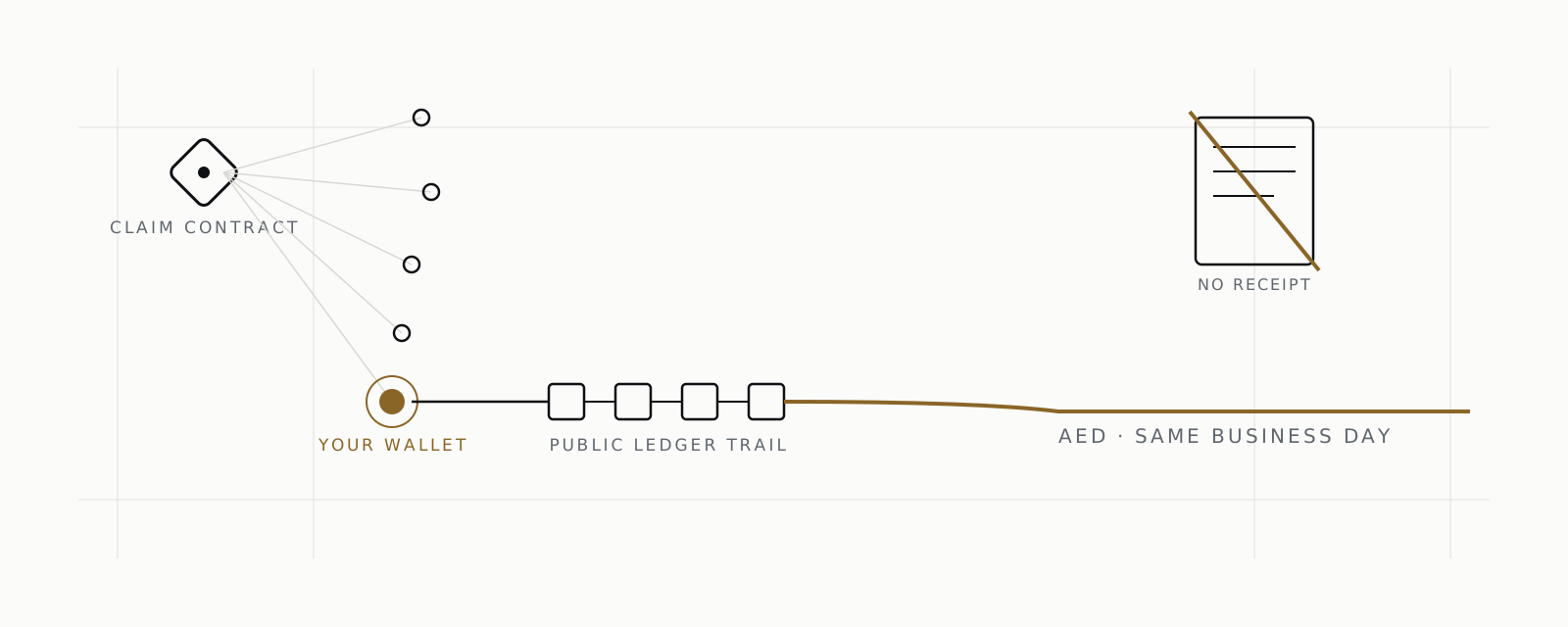
Cashing out airdrop tokens in the UAE: proof of origin without a purchase receipt
Airdropped tokens have no purchase receipt and no exchange deposit funding them, so a UAE bank or OTC desk asks for different evidence: the on-chain transaction crediting the airdrop from the project's contract, the project's own claim announcement, and the wallet trail from that address to the one you sell from.
KEY FACTS
| Regulator | VARA (Dubai, outside the DIFC) |
|---|---|
| Core airdrop evidence | On-chain claim transaction plus the project's own announcement |
| Token acceptance test | Independently verifiable market price and tradable liquidity |
| EDD trigger | From around 100,000 USDT-equivalent, or any token with no recognised listing |
| IWGT spread | 0.08%–0.40%, by ticket size |
| AED settlement | Same business day (UAEFTS) |
| USD settlement | 2–5 business days (SWIFT) |
Source: IWGT published pricing bands and onboarding practice, as of September 2026.
Why does a UAE desk need different evidence for airdropped tokens?
An airdrop is a free distribution of tokens to a wallet, triggered by using a protocol, holding a different asset at a snapshot date, or completing a set task — never by a purchase. Because nothing was bought, the two records a crypto source-of-funds file normally leans on do not exist: there is no purchase receipt, and no fiat deposit funded the exchange account or wallet balance the tokens sit in.
A UAE bank or licensed OTC desk still needs to know where the tokens came from before settling a sale to AED, particularly once a ticket approaches the size that triggers enhanced due diligence. For an airdrop, that evidence exists — it is simply a different kind of record than a trade confirmation.
What does the receiving wallet's own transaction history prove?
The first fact a reviewer checks is the transaction that credited the airdrop, visible on the network's own block explorer by wallet address, date and the contract address that sent the tokens. Once included in a finalised block, an Ethereum transaction is, in the Ethereum Foundation's own words, secure against alteration "by a network level attack that would cost many billions of dollars" — the same permanence applies to the equivalent record on BNB Chain or Tron.
That single transaction answers the two questions a purchase receipt would otherwise answer: when the tokens arrived, and which contract sent them. Everything after that point is an ordinary wallet history, the same as any other crypto holding.
How does the project's own claim page or announcement help?
Most airdrops are announced publicly before or at the moment tokens become claimable, naming the eligibility rule, the snapshot date and the contract address tokens are sent from. That published record corroborates the wallet's own transaction: the dates line up, the contract address matches, and the eligibility rule explains why the wallet qualified at all.
| Evidence type | What it shows | Where it comes from |
|---|---|---|
| On-chain claim transaction | Date, amount and the sending contract address | The network's own block explorer |
| Project's claim announcement | Snapshot date, eligibility rule, distribution contract | The project's official site, blog or governance forum |
| Wallet ownership continuity | That the claiming address is one you control and sell from | Your own wallet's transaction history |
| Conversion record (if applicable) | That a swap to USDT or another asset matches the original balance | Exchange trade confirmation or on-chain swap transaction |
The claim transaction and the project's own announcement do the work a purchase receipt would otherwise do; the other two rows apply to any crypto sale, airdropped or not.
Does it matter which network the airdrop arrived on?
Ethereum, BNB Chain and Tron are the three networks most airdrops of recent years have used, and each keeps the same kind of permanent public record. BNB Smart Chain's own documentation describes a network that validates and verifies every transaction and account state, and Tron's transaction documentation describes the same idea: a signed instruction that updates the ledger and stays there. Whichever chain distributed the tokens, the evidence a UAE desk asks for is the same — the claim transaction and, where one exists, the project's own announcement.
Which airdropped tokens can a licensed desk actually sell?
A licensed virtual asset service provider's compliance policy generally accepts a token for sale only if it has an independently verifiable market price and enough trading liquidity to be priced and screened without moving the market — the same test applied to any asset, not one specific to airdrops. A newly created token with no listing on a recognised exchange cannot be priced this way, however it was received.
This follows the same risk-based logic behind FATF's guidance for virtual asset service providers: a provider needs to be able to assess and price what it is converting before it can screen where the value came from. An airdropped token that has traded on a recognised exchange for some time is straightforward to sell; a claim with no market behind it yet is not something a desk can settle at any size.
How is an airdrop different from token-sale proceeds or staking rewards?
Cashing out token-sale proceeds starts from a signed contract — a SAFT or token purchase agreement — that created the allocation and usually sets a vesting schedule. An airdrop has neither, since nobody applied for it or agreed to a lock-up.
Converting staking rewards starts from a delegation or validator history that produced many small payouts over time. An airdrop is usually one credit on one date, sometimes repeated across separate campaigns from different projects, but never built from a running position. Mining proceeds sit closer to an airdrop in one sense — both are received rather than bought — but a mined coin's origin is the coinbase transaction paying for computational work, not a snapshot of an unrelated wallet balance or protocol usage.
What if the tokens moved through several wallets before you sell?
A documented chain from the original claim address to the wallet you sell from is normal and expected — most holders move tokens at least once, to a hardware wallet or an exchange account. List each address the tokens passed through, in order, with the transaction hash for each hop.
One habit weakens an otherwise clean file: consolidating the airdrop into a brand-new wallet immediately before selling, with no note connecting it to the original claim address. A reviewer reads an unexplained gap as risk regardless of how the tokens were actually earned, so keeping the hop list next to the claim transaction is worth the few minutes it takes.
How do you prepare an airdrop source-of-funds file, step by step?
Assembling the file for an airdrop takes four steps once you know what a reviewer is looking for.
-
STEP 1
Pull the claim transaction from a block explorer
Look up the wallet address on the network's own explorer — Etherscan, BscScan or Tronscan — and save the transaction that credited the airdrop: date, amount and the sending contract address.
-
STEP 2
Save the project's own announcement
Keep a copy of the project's claim page, blog post or governance-forum notice stating the snapshot date and eligibility rule. A screenshot with the URL and date is enough if the page later changes.
-
STEP 3
List every wallet the tokens passed through
Note each address in order, with the transaction hash for each transfer, from the original claim wallet to the one you plan to sell from.
-
STEP 4
Add the conversion record, if you swapped before selling
If the airdropped token was exchanged for USDT or another asset first, include that trade confirmation or on-chain swap transaction to close the last gap before the sale. A licensed desk settles only to your own-name account, so the receiving wallet or exchange account should match the name on file.
The bottom line on cashing out airdrop tokens in the UAE
Cashing out airdrop tokens in the UAE relies on the same kind of evidence a bank or desk would want for any crypto sale, just drawn from a different source: the claim transaction and the project's own record stand in for a purchase receipt. Source of funds, in this case, means proving where the tokens entered your wallet, not how much you paid for them.
Check that the token has a recognised market price before assuming a desk can settle it, verify any desk's licence status, and see the published spread bands before you start the file.
FAQ
Do I need a purchase receipt to sell airdropped tokens in the UAE?
No. Airdropped tokens are not bought, so there is no purchase receipt to produce. A UAE bank or OTC desk instead reviews the on-chain transaction that credited the airdrop to your wallet, together with the project's own claim announcement or documentation.
What if I no longer have access to the wallet that first received the airdrop?
The on-chain record survives even if you have since moved to a new wallet or lost access to the old one. What matters is a documented, unbroken chain of transfers from the original receiving address to the wallet you sell from today.
Can a UAE desk sell any airdropped token, regardless of size or listing status?
No. A licensed desk's compliance policy generally limits accepted tokens to those with an independently verifiable market price and enough trading liquidity to be priced and screened — a newly created token with no recognised listing does not meet that bar, however it was received.
Does it matter whether the airdrop was distributed on Ethereum, BNB Chain or Tron?
Not for the principle involved. Each network keeps a permanent, publicly readable transaction record through its own block explorer — Etherscan for Ethereum, BscScan for BNB Chain, Tronscan for Tron — so the same claim-transaction evidence works regardless of which chain the airdrop ran on.
Does the UAE tax airdropped tokens?
The UAE has no personal income tax, so an individual does not owe UAE tax on receiving or selling airdropped tokens. A UAE company that receives airdrops as part of its treasury may count their value toward Federal Corporate Tax; tax rules in your own country of residence are a separate question this guide cannot advise on.
Sell airdropped tokens to a desk that reads the claim trail
IWGT is a VARA-licensed Broker-Dealer in Dubai (VL/24/12/002). We review on-chain claim transactions and project documentation as standard source-of-funds evidence for tokens with a recognised market, then settle AED by UAEFTS the same business day.
SOURCES
- VARA public register — licence status check, accessed 22 September 2026.
- Ethereum Foundation — Transactions documentation, accessed 22 September 2026.
- BNB Chain — BNB Smart Chain overview documentation, accessed 22 September 2026.
- TRON — Transaction structure documentation, accessed 22 September 2026.
- FATF — Updated Guidance for a Risk-Based Approach to Virtual Assets and VASPs (October 2021), accessed 22 September 2026.
- Uniswap Governance — UNI airdrop claim requirements (17 September 2020), accessed 22 September 2026.
- IWGT published pricing bands and onboarding requirements — IWGT published pricing bands, September 2026.
This guide is informational and is not legal, tax or investment advice, nor an invitation to buy or sell any virtual asset. Rules and figures are as of September 2026 — re-check the sources before acting. Virtual assets may lose their value in full or in part and are subject to extreme volatility.