
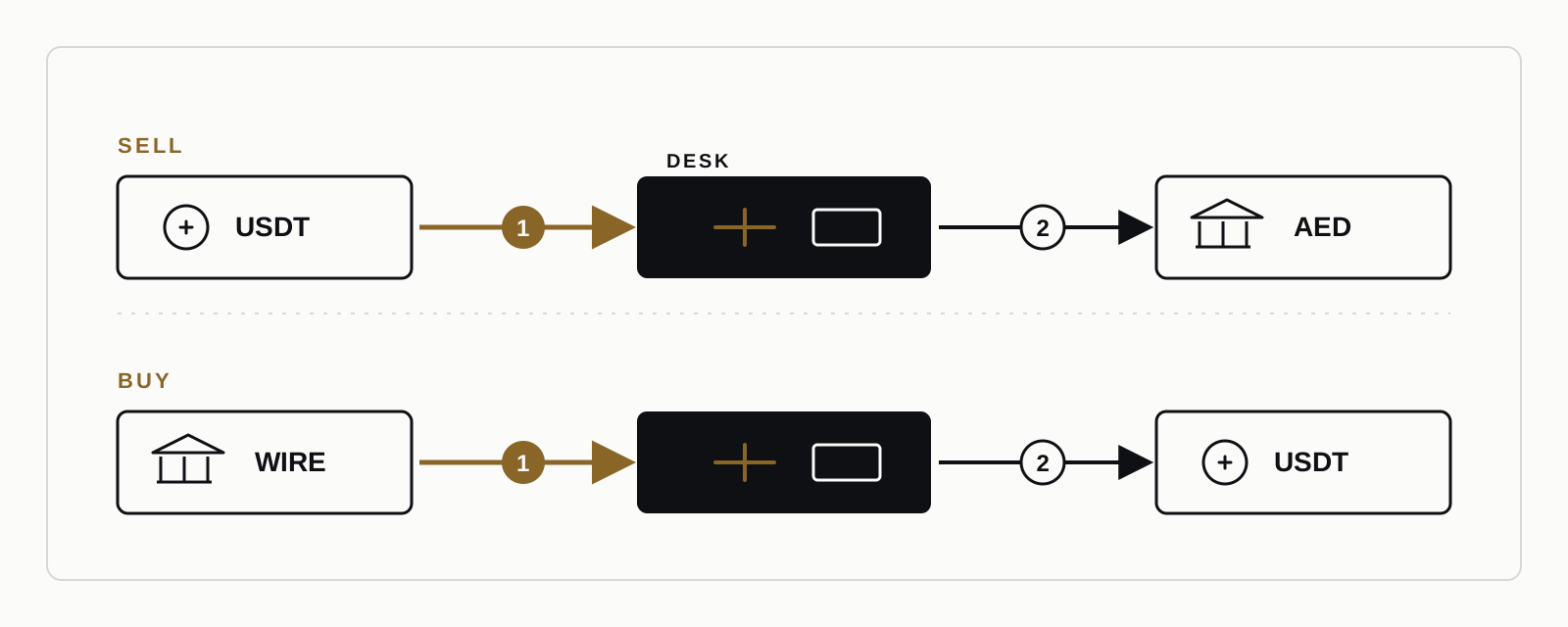
Who sends first in an OTC USDT trade in Dubai, and do you need a USDT escrow?
At a licensed desk there is no third-party escrow, because the VARA-licensed desk is the principal counterparty. On a sale, you send USDT only after accepting the written quote, and AED lands in your own-name account the same business day by UAEFTS. On a purchase, you wire first from an own-name account; USDT follows once funds clear.
KEY FACTS
| Direction | Who moves first | Timing | What protects you |
|---|---|---|---|
| You sell USDT | You send USDT, after you accept the written quote | AED by UAEFTS the same business day; USD by SWIFT in 2 to 5 business days | VARA licence on the register, client money rules, written quote, test transfer to a new address |
| You buy USDT | You wire first, from an own-name account | Wire reaches the desk through a correspondent bank in 2 to 5 business days; USDT follows once funds clear | VARA licence on the register, rate fixed in writing before the wire, whitelisted wallet, tx hash |
Source: IWGT published terms on the main page and VARA Rulebooks, as of October 2026.
Who sends first when you sell USDT to a licensed desk?
When you sell USDT to a licensed desk, you send first, but only after you have accepted a written quote. The quote names the price, the network and the deposit address, so the coins move against a known amount of dirhams. Before you transact, check the desk's VARA licence in the public register.
The sequence has four steps, and none of them needs an intermediary.
-
STEP 1
Approve the account and request the quote
You verify your identity once and state the amount and the payout currency. A dealer returns one written price.
-
STEP 2
Accept, then send USDT
You send to the address and network on the quote, not to an address from an older chat. Sending before you accept leaves the coins unpriced.
-
STEP 3
Wait for the deposit to confirm
The payout follows the confirmed deposit, so the fiat leg starts only when the coin leg is visible on-chain.
-
STEP 4
Receive fiat in your own name
As of October 2026, AED goes out by UAEFTS the same business day once the account is approved, and USD goes by SWIFT in 2 to 5 business days. The account must be in your own name.
Your exposure on the sale is the short interval between the confirmed deposit and the bank credit. That interval is the reason the licence check comes first, not an escrow after it. If a leg runs late, our guide to where OTC settlements fail and who bears the cost sorts each case by cause.
Who sends first when you buy USDT with a bank wire?
When you buy USDT with a bank wire, you send first. The desk's published terms for buying USDT with a bank wire require the wire to come from an account in your own name, and the USDT goes to a wallet you whitelisted in advance.
The wire is slower than the coin leg for a simple reason: money moves through correspondent banks, and each one adds checks. As of October 2026 the desk's published window for funds to arrive is 2 to 5 business days. The rate is agreed in writing before you wire, so the days in transit do not change the price.
Once the credit is confirmed, the desk sends USDT on the network you chose and gives you the transaction hash. That hash is your proof of delivery. A small test transfer to a new address first is normal practice, and the desk's published terms say it costs nothing extra.
Why does a licensed desk not need a third-party USDT escrow?
A licensed OTC desk does not need a third-party USDT escrow because the desk is the counterparty to your trade, not a go-between. An escrow exists to hold one side's asset while a stranger performs. Here you deal with a regulated firm that has put its licence and its client-asset obligations behind the trade.
Three rules in VARA's rulebooks do the work an escrow agent would otherwise do. First, Regulation III.A.1 bars any entity from carrying out a VA activity by way of business in Dubai unless it is licensed or exempt, so the firm on the other side is on a register you can read. Second, under the Client Money Rules (Rule IV.B.2), client money must be held in a Client Account and is "not owned by the VASP" and does not form part of its estate. Third, the Client Virtual Assets Rules (Rule V.B.3) require client virtual assets to sit in wallets separate from the firm's own.
The same Schedule 1 also explains why the desk can be the other side of your trade. Broker-Dealer Services include "entering into Virtual Asset transactions as a dealer", and Exchange Services include "conducting an exchange, trade or conversion between Virtual Assets and fiat currency". A firm licensed for those activities trades with you directly, so there is no second party whose performance an escrow would have to guarantee.
These rules protect what the desk holds for you during settlement. They do not remove the need for your own checks: the written quote, the own-name account and the whitelisted address are what stop a payment going astray. One of those checks is the network. USDT exists on several chains, and Tether lists Tron (TRC20) and Ethereum (ERC20) among its supported protocols, so the network on the quote must match the one your wallet uses.
Property is a separate subject. A RERA escrow account holds dirhams for an off-plan purchase and cannot take crypto; the route from coins to that account is covered in our guide to paying a RERA property escrow from USDT.
What should you ask about a P2P "USDT escrow" offer?
Ask who licenses the escrow. In Dubai, holding virtual assets for other people is a licensed custody activity: Schedule 1 of the VARA Regulations lists Custody Services as "safekeeping Virtual Assets for or on behalf of another Entity". An offer to hold your USDT until the other side pays is that activity under another name.
A licence is something you can verify, so make the question concrete before any coin moves.
- Which entity holds the coins, and is it on the VARA register with a custody activity listed against it?
- Is the escrow party independent of the counterparty, or is it the same person under a different handle?
- Where is the written statement that client coins are held separately from the firm's own?
- What happens if the other side disputes the trade, and who decides?
| Question | Licensed desk as counterparty | P2P offer with an "escrow" |
|---|---|---|
| Who holds the coins in between? | The licensed desk, under client asset rules | A third party that needs its own custody licence |
| Where do you verify the licence? | VARA public register, by name and activity | Same register, for the escrow party and for the platform |
| Who is the counterparty? | The desk itself | An unknown person, possibly the escrow party |
| What is written down? | Quote, trade confirmation, bank credit in your name | Platform chat and a status label |
The licensed route has fewer parties and more paper; the escrow route adds a party whose licence you must verify separately.
If the answers are a chat handle, a promise of "verified escrow" and a request to move the coins first, treat the offer as unlicensed. The patterns in crypto OTC scams in Dubai show how a fake escrow is used to take the first transfer. The VARA register covers Dubai outside the DIFC, so check the right regulator for the jurisdiction in the offer.
Is a test transfer normal, and is splitting the ticket?
A test transfer is normal; splitting the real ticket into many pieces is not. A test sends a small amount to a new address to confirm the address and the network. It is one step in one trade, and it ends when the full amount follows.
Splitting is a different act: dividing one sale into several smaller tickets so that each looks smaller. Licensed desks and banks look at linked transactions together, and a pattern built to stay under review bands draws more attention, not less. The full reasoning, with the cost difference, is in our guide to why splitting a USDT sale does not avoid checks.
What does the order of steps look like in a worked case?
The same trade on a P2P board with an "escrow" holding the coins would add one more unknown at the point where the money is exposed. The licensed route removes that party instead of supervising it.
The bottom line on who sends first
Who sends first depends on the direction: you send USDT after the written quote when you sell, and you wire first when you buy. Neither direction needs a third-party USDT escrow at a licensed desk. Check the licence, read the quote, use your own account and a whitelisted wallet, and treat any escrow that cannot name its licence as a custody service you should not use.
FAQ
Do I need a USDT escrow service to trade with an OTC desk in Dubai?
No. A VARA-licensed desk is itself the counterparty, so there is no third party holding your coins or your money between you and the desk. The protection comes from the licence, the client money rules and a written quote.
Should I send USDT before I have a written quote?
No. Accept the written quote first, then send the USDT to the address and network the quote names. Coins that arrive before acceptance have no price attached, and the market can move until you are quoted.
When does the desk send my USDT after I buy with a wire?
Once the funds have cleared. As of October 2026 the wire reaches the desk through a correspondent bank in 2 to 5 business days, and USDT then goes to your whitelisted wallet with a transaction hash.
Is a small test transfer normal in an OTC trade?
Yes. A small test transfer to a new address confirms the address and network before the full amount moves. Splitting the real ticket into many pieces is a different thing and draws more checks, not fewer.
Is a property escrow account the same as a USDT escrow?
No. A RERA property escrow account is a dirham bank account for an off-plan purchase and cannot receive USDT. A USDT escrow offer would involve someone holding coins for you, which is a separate, licensed activity.
Trade against a licensed desk, with the quote in writing
IWGT is a VARA-licensed Broker-Dealer in Dubai. Sell USDT for AED or USD, or buy USDT with a wire from your own account. Spread bands are published openly, by ticket size and by direction.
SOURCES
- VARA Rulebooks, Virtual Assets and Related Activities Regulations 2023, Part III.A: General Prohibition and Exemptions (Regulation III.A.1), accessed 13 October 2026.
- VARA Rulebooks, Regulations Schedule 1: VA Activities (Custody Services; Broker-Dealer Services), accessed 13 October 2026.
- VARA Compliance and Risk Management Rulebook, Part IV.B: Treatment of Client Money (Rule IV.B.2), accessed 13 October 2026.
- VARA Compliance and Risk Management Rulebook, Part V.B: Treatment of Client VAs (Rules V.B.2 and V.B.3), accessed 13 October 2026.
- VARA public register: licensed VASPs and licensed activities, accessed 13 October 2026.
- VARA Compliance and Risk Management Rulebook, Part V: Client Virtual Assets Rules (VARA's jurisdiction across Dubai outside the DIFC), accessed 13 October 2026.
- Tether, supported protocols (USDT on Tron and Ethereum), accessed 13 October 2026.
- Central Bank of the UAE, payment systems (UAEFTS), accessed 13 October 2026.
- IWGT published licence details and published settlement terms for sales and purchases, October 2026.
This guide is informational and is not legal, tax or investment advice, nor an invitation to buy or sell any virtual asset. Rules and figures are as of October 2026; re-check the sources before acting. Virtual assets may lose their value in full or in part and are subject to extreme volatility.