
Can Tether freeze your USDT, and what a blacklisted address means in the UAE
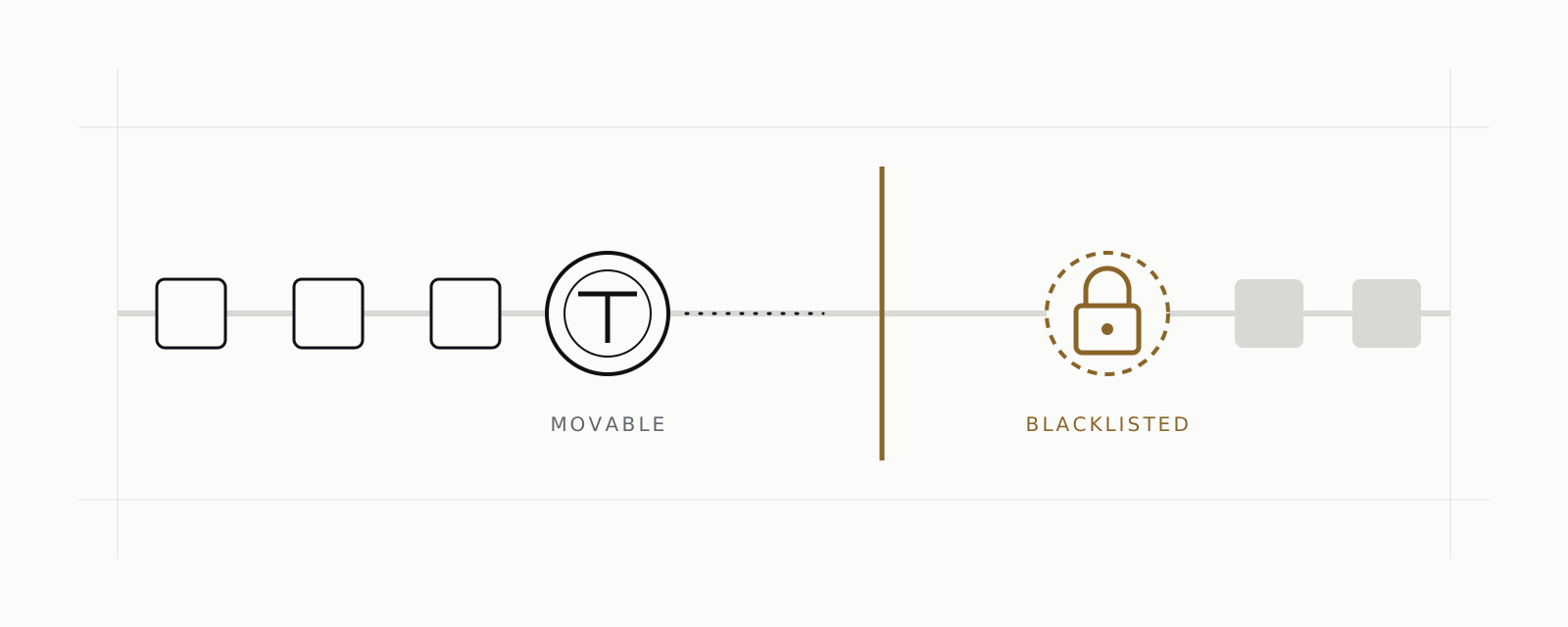
Yes. The USDT contracts on Tron and Ethereum let Tether blacklist an address, and from then on the balance cannot be moved or sold. Freezes follow law-enforcement requests and sanctions alignment. A blacklisted address cannot be sold through any desk, so check before you trade.
KEY FACTS
| Can USDT be frozen? | Yes, by Tether, through a blacklist inside the token contract |
|---|---|
| Effect on the holder | Balance still shows, but no transfer or sale is possible |
| Iran-linked freezes in 2026 | Approximately $550 million (Tether release of 28 September 2026) |
| How to check an address | Read function on the contract page, Tronscan or Etherscan |
| Desk behaviour | Screens the sending wallet; payout only to your own account |
Source: Tether press release of 28 September 2026 and the verified USDT contract on Etherscan, accessed October 2026.
How can Tether freeze USDT at all?
Tether can freeze USDT because the token is a contract it administers, not a bearer asset like cash. The Ethereum contract, named TetherToken on Etherscan, includes an addBlackList function that only the contract owner can call, and a matching removeBlackList. Once an address is listed, transfers from it fail.
The contract also holds a destroyBlackFunds function for balances at listed addresses, so a freeze is not always only a pause. In December 2023 Tether announced a voluntary wallet-freezing policy tied to the U.S. Treasury's OFAC SDN list, covering addresses already listed and those added later (as of October 2026, per tether.io). Our page on how sanctions screening works on a UAE crypto sale covers the screening side from the desk's chair.
What does a blacklisted USDT address mean in practice?
A blacklisted address keeps its USDT balance on the ledger, but every attempt to send that USDT is rejected by the contract. Your wallet app may still show the balance, which is why people think the coins are "there". They are there, and they are locked.
Three consequences follow. The holder cannot sell, swap or withdraw. Anyone who received coins from that address earlier is not affected by the freeze itself, though their own history now touches a flagged address. And the address stays listed until Tether removes it, which is a decision outside the holder's control.
How much USDT did Tether freeze in 2026?
Tether's release of 28 September 2026 states that approximately $550 million of Iran-linked USDT was frozen in 2026. Within that, it describes a freeze of more than $344 million across two addresses in April, and more than $130 million across four wallets in July, after Treasury expanded a Central Bank of Iran designation to four further TRON addresses.
The same release says Tether's cooperation with authorities has resulted in more than $5 billion in assets frozen, including more than $2.4 billion connected to U.S. authorities, and that Tether can act when credible information is provided by law enforcement. All figures are Tether's own, as of 28 September 2026, and cover its whole law-enforcement cooperation, not only Iran-linked cases.
How do you check whether an address is blacklisted?
You check an address by calling the contract's public blacklist read function on a block explorer. The verified Ethereum contract exposes isBlackListed(address) and getBlackListStatus(address), both read-only, and both return true or false. No wallet connection or fee is needed.
-
STEP 1
Open the USDT contract page
On Etherscan use the verified USDT token contract, or on Tronscan the USDT token contract for the Tron network. Type the address into the explorer yourself rather than following a link from a chat message.
-
STEP 2
Go to Read Contract
Open the contract tab, then Read Contract, and find the blacklist read function. On Etherscan it is
isBlackListed. -
STEP 3
Paste the address and query
False means the address is not listed at this moment. True means it is blacklisted. Note the time of the check.
A false result is a snapshot, not a clearance. An address can be listed later, and the check says nothing about where its coins came from.
Who decides when funds are frozen: Tether, an exchange, a bank or a desk?
Four different bodies can stop your money, and each works on different rules and offers a different way back. Mixing them up wastes the first week, so identify which one you are dealing with before you write to anyone.
| Type of stop | Who decides | What it looks like | What you can do |
|---|---|---|---|
| Issuer freeze (Tether blacklist) | Tether, after law-enforcement information or sanctions alignment | Contract rejects every transfer; read function returns true | Nothing on-chain. Contact the authority behind it or Tether through counsel |
| Exchange account hold | The exchange's compliance team | Withdrawals or trading restricted inside the account; the address on-chain is clean | Answer the verification request; escalate through the exchange's support |
| Bank account freeze | The bank, or an authority issuing an order to it | Debits blocked or the account restricted, with a request for documents | Provide the file in writing; see the bank-side steps linked below |
| Desk decline | The desk's compliance function | The trade is refused before settlement, with no funds moved | Ask what was missing, fix it, and re-submit if the reason is curable |
Only the first row lives on-chain; the other three are decisions by a firm, so the answer is a conversation and a document file.
The question "why is my USDT frozen on Binance or Bybit" almost always lands in the second row. Check the address on the read function first. If it returns false, Tether has done nothing and the restriction sits with the exchange. For the bank row, see how to prepare a paper trail before a cash-out and, if it has already happened, the steps to get a frozen UAE bank account reopened.
Is USDT traceable?
USDT is traceable because every transfer on Tron and Ethereum is recorded on a public ledger, readable by anyone through Tronscan or Etherscan. Addresses are not names, but each transfer shows sender, receiver, amount and time, and the history of an address stays visible for good.
That visibility is what makes freezes workable. When an authority identifies an address, it can follow where coins went next, and Tether can list the addresses that hold them. It also means a desk can read the history of the wallet that is about to send it coins. A clean-looking address with a long, ordinary history is easy to accept; one that sits a few hops from a listed address needs explaining.
Why do coins from unknown P2P counterparties carry freeze risk?
Coins bought from an anonymous P2P counterparty carry freeze risk because you inherit their on-chain history without being able to see their reasons. The seller's address may already sit near a flagged one, or may be listed after your purchase, and the freeze then hits the address that holds the coins, which is yours.
The risk compounds with size. A seller who wants cash or a quick release can be a mule for funds from another source, and you cannot tell from a chat profile. If you already hold coins from such a source, see why a UAE OTC desk declines a trade for how those cases are handled, and keep the purchase records. This article offers no way to move coins around a freeze, and none exists that is lawful.
What does a licensed desk do about frozen or flagged USDT?
A licensed desk screens the sending wallet before it accepts a trade, cannot take tokens that are frozen, and pays out only to an account in the client's own name. This is process, and it protects both sides: the client is not left holding a payout tied to a flagged source, and the desk stays inside its licence conditions.
- The wallet you will send from is checked against sanctions lists and the contract's blacklist status before the quote is confirmed.
- A blacklisted address cannot send at all, so a frozen balance is not a tradeable one at any price.
- Settlement is made to your own named bank account; a payout to a third party is refused.
IWGT, operated by OFZA Fintech Virtual Asset Exchange Services LLC under VARA licence VL/24/12/002 (see the licence section on our main page), sells USDT for AED the same business day through UAEFTS, with a spread of 0.40%, 0.25%, 0.15% or 0.08% by tier at 100k, 500k, 2M and 10M (as of October 2026). To have a wallet and size reviewed before you send anything, request a quote.
Does a freeze affect USDT's price?
A freeze of one address does not change the price of USDT, because the frozen tokens stay in supply and the rest of the market is unaffected. The separate question of whether the whole coin holds its dollar value is covered in the review of USDT depeg risk.
The bottom line on Tether freezes
Tether can and does freeze USDT, and the freeze is on-chain, public and checkable with one read call. Check the sending address on the explorer, keep your acquisition records, avoid anonymous counterparties for size, and sell to a desk that screens the wallet and pays to your own account.
FAQ
Can USDT be frozen?
Yes. The USDT contracts include a blacklist, and once an address is on it the balance cannot be transferred. Tether says it acts when credible information comes from law enforcement and that its freezing policy is aligned with the OFAC SDN list.
Can Tether unfreeze a blacklisted address?
The contract has a function that removes an address from the blacklist, and only Tether controls it. Whether it is used is Tether's decision, usually following the authority that requested the freeze, so the owner has no on-chain way to release the balance.
Why is my USDT frozen on Binance or Bybit?
An exchange hold is usually an account-level compliance restriction set by the exchange, not a Tether blacklist. Check the sending address on the contract's read function first; if it is clean, the exchange's support and compliance team is the one to ask.
Does a desk have to refuse frozen USDT?
Frozen tokens cannot be sent at all, so there is nothing for a desk to accept. A licensed desk also screens the sending wallet before a trade and declines a wallet that is blacklisted or sanctioned.
Is a clean address check a guarantee?
No. The check shows the status at the moment you look. An address can be added to the blacklist later, including after coins pass through it.
Sell USDT from a wallet that has been checked
IWGT is a VARA-licensed Broker-Dealer in Dubai. The sending wallet is screened before the trade, AED goes by UAEFTS the same business day, and payout is made only to an account in your own name.
SOURCES
- Tether: Tether Has Supported Nearly $550 Million in Iran-Linked USD₮ Freezes as U.S. Expands Sanctions Campaign, 28 September 2026, accessed October 2026.
- Tether: Tether Introduces New Policy to Strengthen Ecosystem Security, December 2023, accessed October 2026.
- Etherscan: verified USDT (TetherToken) contract, Contract and Read Contract tabs, accessed October 2026.
- U.S. Treasury OFAC: SDN list, accessed October 2026.
- IWGT published pricing bands: IWGT pricing, October 2026.
This guide is informational and is not legal, tax or investment advice, nor an invitation to buy or sell any virtual asset. Rules and figures are as of October 2026, re-check the sources before acting. Virtual assets may lose their value in full or in part and are subject to extreme volatility.